
Stop Burning Cash in Montreal Digital Marketing 2026
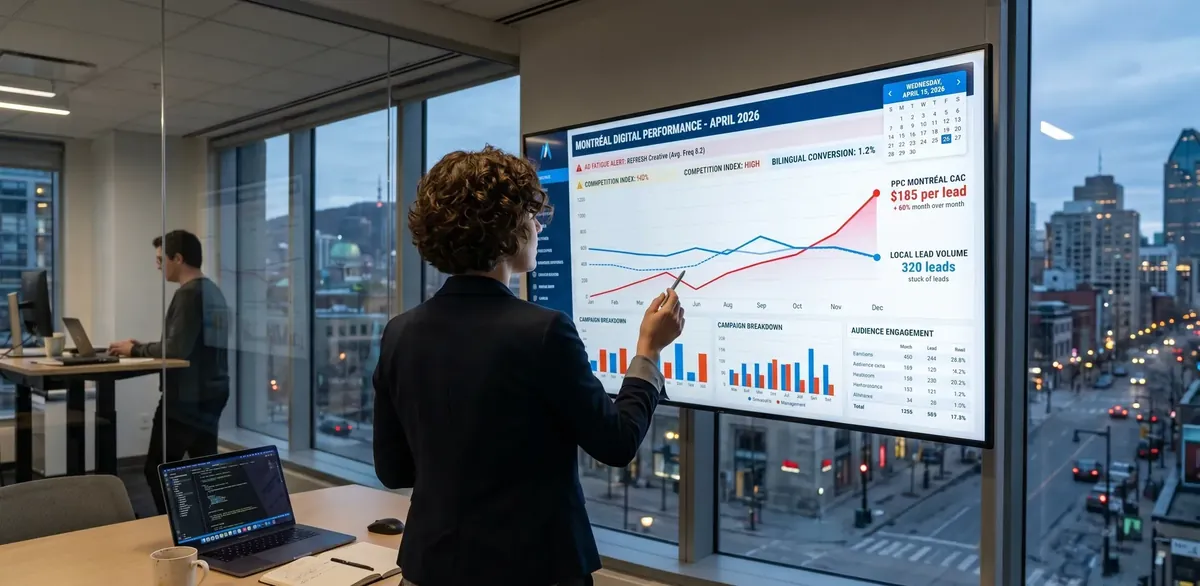
Table of Contents
If you are a marketing director in Montreal, you have likely felt the shift. It's 2026. Strategies that scaled your ad campaign in 2024 are now costing you money. The unique, bilingual nature of our city makes this challenge even harder. Your Cost Per Acquisition (CPA) is climbing, your ads are fatiguing fast, and despite a larger budget, your leads have stagnated.
The reality of Montreal digital marketing in 2026 is that you can no longer rely on "hacking the algorithm." You are competing in a dense market where attention is expensive. Scaling is no longer about finding a "hidden audience" on advertising platforms. Success now depends entirely on building a fast-paced "Creative Engine" — producing high-intent, localized content at scale to engage your target audience.
In 2026, businesses in Greater Montreal running high-volume campaigns on visual platforms (TikTok, Meta) must refresh ad creative every 7 to 14 days. Local competition is fierce, and the algorithm quickly identifies and penalizes stale, static content. This frequency combats "ad fatigue" and keeps your message relevant to local consumers.
The Montreal "Winning Ad" Case Study
At our PPC agency based in Quebec, we recently reviewed a recognized Montreal B2C brand. They operate out of the Plateau and tried to scale a single "winning ad" for six consecutive months.
The marketing efforts started strong. But by month three, things broke down. The average Montreal user had seen the same ad eight times, and campaign performance plummeted.
Frequency was at 8.0, which guaranteed local user disengagement. The algorithm penalized the lack of fresh content. CPMs doubled. The client was spending more money, but the phone at their bilingual call centre stopped ringing. They fell into the "winning ad" trap, ignoring the need for rapid creative iteration. Static campaigns do not scale in a modern ROI model — you cannot "set-and-forget" any ad campaign.
Data Shows Creative Wins Over Targeting
International data and our own case studies confirm the shift: refined targeting is now less important than creative volume.
Internal data from Meta in 2026 confirms that "Creative" is the #1 driver of campaign performance, outweighing targeting by a massive 4:1 ratio. This happened because algorithm-driven audience modelling is now nearly perfect. Platforms like Meta and TikTok already know who your best client is in Brossard or Saint-Henri, and they identify high-intent users faster than we can.
Your job is not to find them. Your job is to provide content that connects with them. In a bilingual market like Montreal, that means diverse, localized creative variations. Give the AI enough varied assets and it will drive your desired action; starve it and you will plateau.
Data from ProfitWell indicates B2B CAC has risen 60% over the last five years. In Montreal's tight, localized market, efficiency is a requirement. To protect margin, pair specialized localized creative with focused destinations. You cannot drive high-cost 2026 traffic to a generic homepage; every click must count toward the action you want.
The Montreal Bilingual Challenge in 2026
Scaling in Montreal in 2026 requires a highly specialized local approach. This is not about translating your Toronto ads. You cannot scale without a dedicated bilingual plan.
AI-driven advertising platforms in 2026 are smart. They detect the difference between a native localized speaker and a generic, dubbed translation, and cheap translations get flagged by the local algorithm as "Low Quality."
- Native French production (with Quebecois cultural references).
- Native English production (speaking to the unique Anglo-Montreal experience).
- Authentic localized connection, which is required for building trust.
Real Montrealers can tell whether you are speaking to them or at them. Authentic connection drives better performance and a higher return on investment.
The fastest way to combat ad fatigue is to connect with the local audience immediately. Use specific Montreal hooks in your first three seconds:
- "Trying to find parking near Atwater Market..."
- "That feeling when the Metro is stuck at Berri-UQAM..."
- "If you are tired of the construction on the Décarie..."
These references create instant localized relevance and differentiate you from global competitors blanket-targeting the province.
Implementing the Montreal "Creative Engine"
To stop burning cash and start scaling in 2026, you need to transform your production. Stop thinking about filming a commercial once a quarter; think about producing 10 to 15 high-intent variations every week.
A "variation" is not a completely new video. It's a change in the crucial variables:
- The Hook: The first 3 seconds are everything. Test local references vs. direct benefit statements.
- The Script: Change the body copy and the tone of voice.
- The Talent: A native French speaker vs. a native English speaker.
- The Visuals: High-quality, authentic video vs. raw, user-generated content (UGC).
- The CTA: Test "Call our Montreal Office" vs. "Get Your Free Quote Online."
A local Montreal PPC agency must pair this creative volume with refined strategy, fine-tuning the content based on local key metrics. This holistic approach turns ads into powerful tools for growth.
Conversion-Optimized Landing Page Design
You must anchor your high-volume creative strategy to a specialized conversion engine. If you increase creative volume but ignore your destination, you will still plateau. Specialized landing page design is the key to managing high B2B CAC.
If your ad creative mentions a specific local pain point, your landing page must continue that story. A generic homepage will kill your conversion rate and your quality score on platforms like Google Ads.
When a visitor clicks an ad focused on Saint-Laurent, the landing page should say "Bilingual Service for Saint-Laurent Businesses." Mention the neighbourhood — "Proudly serving Laval," "Brossard's leading supplier." This small localized touch boosts quality scores, lowers your cost per click, and converts high-cost traffic at a much higher rate.
Conclusion: The Path to Scaling in 2026
Stop burning cash by running last year's ad campaign. To scale paid media in 2026, you cannot rely on granular targeting or static content. You must build a fast-paced Creative Engine that produces high-intent video and copy variations every week.
Your marketing efforts must focus on three core Montreal strategies:
- Native, high-volume bilingual creative that builds social proof.
- Deep, real-world cultural references that combat ad fatigue.
- Geo-targeted landing pages that maximize your desired action.
If your campaigns have stagnated, it's time to move past static ad campaigns and embrace the Creative Engine. Start producing, start localizing, and you will start scaling.
Strategic SEO Checklist for Montreal Paid Media
- Technical: Confirm all landing pages are fully optimized for search visibility and local authority.
- Creative: Ensure every video or visual asset uses localized alt attributes.
- ROI: Track all relevant key metrics (bilingual phone calls vs. form fills) to measure return on investment accurately.
Frequently Asked Questions
Related service: Paid Advertising
Related reading
- LinkedIn Ads for B2B Companies in Montreal: A Practical Guide
LinkedIn Ads are expensive — and worth it when your average contract value justifies the CPC. This guide covers campaign types, audience targeting, bilingual strategy for the Montreal market, and how to measure pipeline contribution rather than just clicks.
- Google Ads vs Meta Ads for B2B: Where to Put Your Budget
They solve different problems. Google captures existing demand; Meta creates it. How to split B2B budget between intent and discovery.
- Google Local Services Ads: A Guide for Quebec Businesses
Pay-per-lead, not pay-per-click. Here's how Google Local Services Ads and the Google Guaranteed badge help Quebec service businesses win jobs before the phone even rings.

Written by
Amit Sahni
Founder & CEO, FutureSource
Amit Sahni founded FutureSource to bring Montreal businesses the revenue-focused marketing usually reserved for funded tech companies. With 20+ years spanning Director of Demand Generation at Salesfloor and senior roles at Nuqleous and Sekure Merchant Solutions, he specializes in paid media strategy, pipeline velocity, CRM automation, and aligning marketing to closed revenue.
Connect on LinkedIn →Ready to architect your growth?
Let's turn your website into a financial asset that drives real revenue.
Schedule a Strategy Call